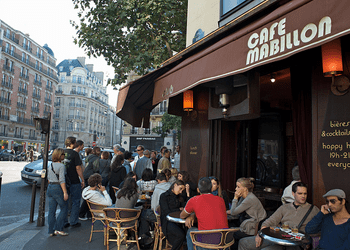
We are sitting under the awning of the Café Mabillon. It is raining in Paris. Not the gauzy rains depicted in the sofa-sized painting that hung in the French-Provincial style living room of my youth, but a torrential rain. With the awning fully extended, Diane and I are dry and snug as we sipped our café crème and espresso. We arrived in Paris an hour earlier having taken the midnight flight (well, it really was the 11:45 flight from New York, but saying the “midnight flight” adds just a touch of mystery and romance – and isn’t that why one travels to Paris?)
So long ago…
It was over thirty years since we had last been here – separately and before we were married. Now, college tuitions are history and living on pensions is still a little ways off, so we have a window of opportunity to go on excursions. Last year we did Prague, Vienna and Budapest (fondly remembered as our summer with the Hapsburgs). This being our 30th anniversary we both agreed on Paris – a place we have fond memories of from our youth. We planned the trip in early spring. Shortly after we made our reservations in May our friend Dave died, suddenly and much too young. The past few months have been painfully sad. The change of scenery and being in a city that always made us happy could only help to lift our spirits.
“It took me two years to get out of Europe, why would anyone want to go back?” – Nathan Bornstein
When last I was saw Paris it was 1979. I had never been to the Continent before that trip. I – and no one in my family – knew anyone in Europe. We were provincial New Yorkers; we knew people in the Bronx and maybe Westchester. Our experience with Europe was limited. My father did spend some time in Paris after the war. He once wrote that “…even in wartime it had a certain charm those terrible times could not hide.” Later I found out that most of his time there was spent in a brothel – but hey, he fought in the Battle of Bulge and liberated the Nordhausen death camp six months earlier – he was allowed. My grandparents were all born in Europe – and came through Ellis Island as young adults. My father’s parents could not understand why anyone would want to go back there (“I walked across Europe to Hamburg and got on a ship for America,” my grandfather Nathan the Seltzerman was fond of saying). My wealthy maternal grandparents did travel to Europe in the 1950’s on the great liners; the Queen Elizabeth and Queen Mary. When they sold their house I came across memorabilia of their travels: the AAA Guide to Europe circa 1955; vellum first-class passenger lists detailing royalty who traveled with their maids; This Week in London – June 7-20, 1955 compliments of the Park Lane Hotel; and embossed menus from Maxim’s in Paris. I devoured this stuff. I always wanted to travel, especially to Europe, and especially to Paris. I planned to go after college graduation with the remaining $3,000 of my “inheritance” (my maternal grandparents left me funds earmarked for education – I had to convince the powers that be that travel was indeed an “education.”), but I worked for a year after graduation and saved an additional $1000, the total amount was to last me for a year.
The plan was to stay in Paris for a few days and then go south. I stayed a lot longer. I found a hotel on the Place Dauphin on Cite – the Henri V – for 20 Francs per night – about five dollars, cheap even then. A legendary fleabag it was the dumpiest hotel in the best location – imagine an SRO fronting Gramercy Park. The guidebooks of the era were Frommer’s Europe on $10 a Day which I eschewed as something for middle class tourists in mismatched clothing with cameras dangling around their necks; and the Harvard student guide, Let’s Go Europe which was a much more acceptable alternative in those pre-internet, pre-computer, pre-cellphone days. Though it was just that – a guide – once one landed and made their way to the hostels, foyers and other low end pensions, word of mouth was the best advice.
Hemingway – though a major prick to so many of his friends and family – certainly got it right when wrote that, “If you are lucky enough to have lived in Paris as a young man, then wherever you go for the rest of your life it stays with you, for Paris is a moveable feast.” Looking back though I was a total cliché come to life. I wore black tee shirts. I sat in cafes and attempted to scribble into my Gilbert Jeune notebook. I kept a pack of Gitanes in my pocket. I attempted to pick up women and speak a few words of French – I was totally unsuccessful on both accounts. But I just felt so at home there and vowed to come back – though I knew instinctively it would be much better to come back with someone I loved.
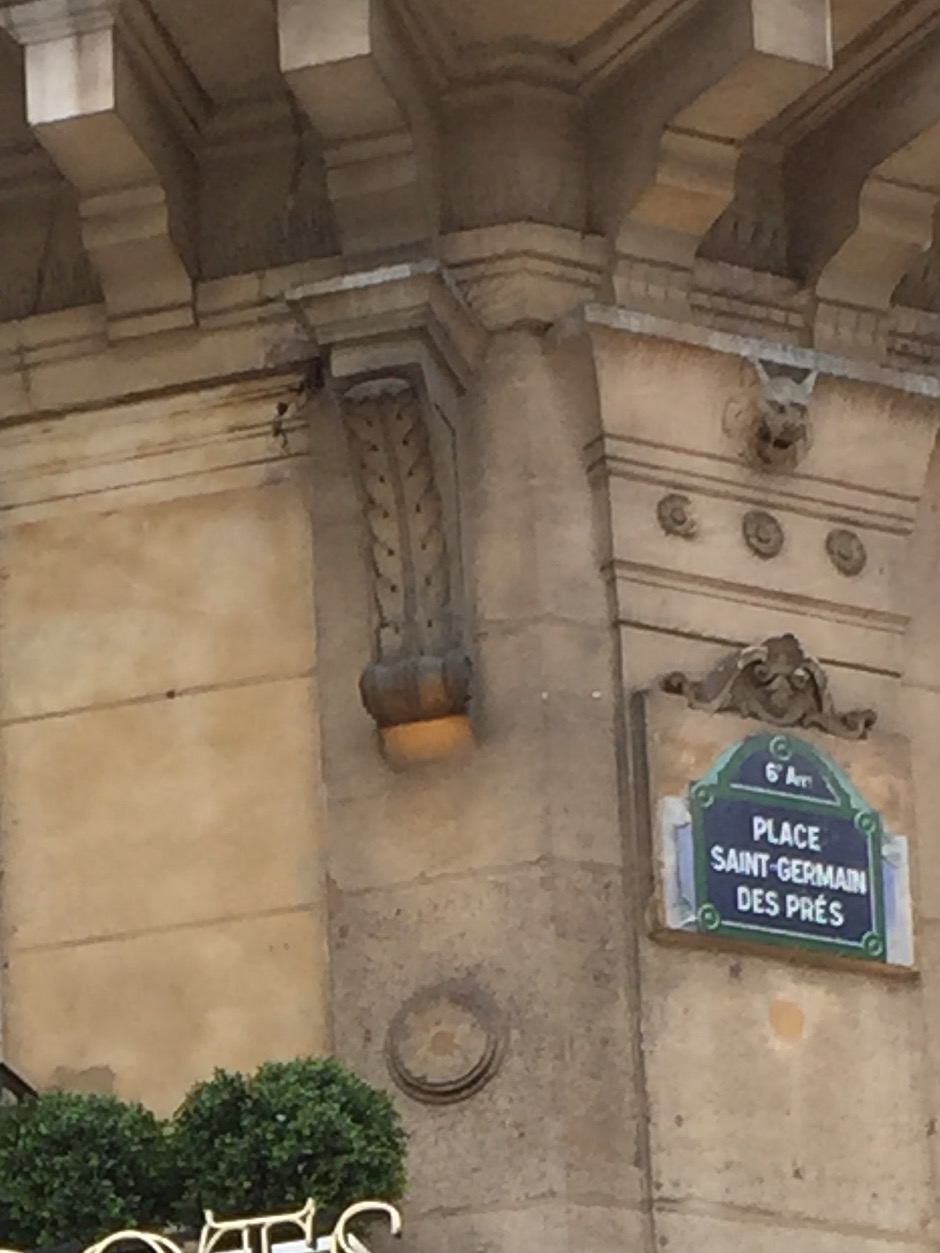
And so I did. More than three decades later Diane and I found ourselves sitting at the Café Mabillon on the Boulevard St. German in the 6th arrondissement. We had a week ahead of us. Admittedly I was a little concerned that my fantasies would crash with reality. We were 60, not 25. The brashness of youth had long given way to the anxieties of aging. We were different. The city was different. One of the benefits of being young is that you aren’t apprehensive – you spend your time “being and doing” – often without thinking it through. And that is probably a good thing.
Plans..well sort of…
We did plan a bit – but not too much. We had a friend in Paris, Christain is a French diplomat who knew Diane from the United Nations, and his daughter Tiphaine remains close to this day with Madeline and Kerry. Christian treated us to the Paris he loves, including the Latin Quarter where he was a student at the Sorbonne, 40 years ago. In addition to his diplomatic skills he is adept at nonchalantly maneuvering his car around the Arc de Triomphe and through the Place de la Concorde. We also had reservations for lunch at Le Grand Vefour, a Michelin rated restaurant we could never have afforded in 1979. And, though we planned to stay within the city (specifically the Left Bank) we did arrange to spend an afternoon at Monet’s gardens in Giverney.
I joked that Diane took special care in curating her wardrobe – but I have to admit that so did I. In Prague and Budapest jeans and tee shirts are fine – but this was Paris after all! We had our anniversary lunch and drinks to think of in this most fashionable of cities. My dark blue linen suit and white linen shirt – rakishly unbuttoned and sans a tie – totally inappropriate at a Queens Chamber of Commerce luncheon; and Diane’s Hollywood style thirties silk movie star pants and black top would be perfect ensembles.
We were glad we packed them because as we sat at the Café Mabillon that first afternoon we noted how stylish the crowds were – even in the rain. The women must have this genetic thing gives them the ability to drape a scarf just perfectly. And the latest trend in menswear seemed to be casual slacks in muted sherbet tones (strawberry, lime, orange and blueberry) I ended up buying pair in the latter and hope I don’t look too foolish. I didn’t shave and attempted the scruffy French facial hair thing that all the guys having going on, but the sad reality is I am not Jean-Paul Belmondo.
Paris is the city of the flaneur and the boulevardier. It is made for walking, stopping to drink a coffee; more walking; stopping to drink a rosé; more walking; stopping for dinner; more walking; stopping for a nightcap. Yes, there are museums and such but they’re just diversions in between imbibing and tasting. I once read that when Baron Haussmann rebuilt the city in the 19th century he created the wide boulevards to protect the government from those Les Miz style student insurrections – the wide streets would give the government forces a leg up on those whiney kids with demands. Maybe it worked for while (though in 1968 Danny the Red used it to his advantage as his comrades gathered and upended cobblestones), but it did create wonderful real estate opportunities. The great boulevards are majestic with classic low rise apartments and chestnut trees and most importantly broad sidewalks with room for cafes of every class. It’s a genius design and creates places where one wants to be and be seen. No matter what the neighborhood they are always filled – even at midnight in the middle of the week.
We did explore the places of our youth. On Cite we paid homage to the Kilometer Zero medallion in front of Notre Dame. We bought books at Shakespeare & Co – which has been cleaned up a bit since George Whitman presided over it. The Hotel Henri V on Place Dauphin is long gone. The waiter at the Taverne Henri V across the street (great 6 euro rose) told us it had been bought by a rich American and converted into a private home (I trust the rich American added some additional bathrooms and hired an exterminator). We looked of the hotel Diane and her sister Laura stayed in so long ago. That too was gone – along with it’s bedbugs. Of course we crossed bridges when we came to them – the favorite being the little one that connects Cite and St. Louis. It’s not the most famous bridge but certainly one of the most romantic.
We went up to Montmartre and strolled around the touristy plaza near Sacré-Cœur. Yes, a tourist trap – but a tourist trap since the Belle Époque so it does seem to work. And on the side street is a great creperie (FYI – crepes are washed down with dry cider).
The Marais was a grungy corner of Paris last time we were there. Formally the Jewish quarter, similar to the Lower East Side, it is now loaded up with trendy designer shops and boutiques and a smattering of Jewish food stalls. We did stumble onto a large wedding in front the main synagogue. It looked to me like a mixed marriage – Sephard and Ashkenaz. The groom was a member of ‘Jews on Bikes’ and a few of his buddies roared their bikes in front of a long white limo. Interestingly I was asked a few times if I was “Askenaz?” Perhaps the scruff on my face did cause some to think I was a cousin of Serge Gainsbourg (non!). Diane fared much better as her natural curls are truly evidence of some latent French gene.
We wanted to see Belleville, which most guidebooks, if they mention it all, note is “diverse” (the universal code word in travel guides for “sketchy”). Christian took us to dinner at Le Vieux Belleville. Since the early 1990’s – when it probably was a truly sketchy neighborhood – the restaurant has served classic French dishes, but the treat is an accordéoniste (colorful, overly made up and just perfect) leading the patrons in classic French songs. The soul of Edith Piaf is alive and well …
Two other culinary highlights were lunch at Le Grand Vefour and drinks at the Bar Hemingway at the Ritz Hotel. We like to go out but we do not patronize world class restaurants – it’s just not our style. Over thirty years ago I walked by the Le Grand Vefour and was impressed. Going back to the early 19th century its clientele over the years have included Napoleon, Victor Hugo and Colette. Though we could have just picked up some bread and cheese and eaten outside in the gardens of the Palais Royal, it seemed like a better idea to actually make a reservation and eat inside. We booked a table for lunch a few months prior. Admittedly I was a little nervous as we strolled over – thinking maybe it would be too haughty and over the top. Though the minute we walked in we were made to feel welcome – and treated to one of the finest meals we’ve ever had. We ordered from the three course prix fixe lunch menu but were treated to a selection of “amuse-bouche” including three dessert plates. Yes, it was pricey – but no more than good seats at the opera or a hit Broadway play. And to dine at the same tables that Victor Hugo and Collette did gave it panache. We were on our best manners – easy for Diane, a little more difficult for me. I now know exactly what shaved truffles taste like – and it’s going to be hard to ever eat perfectly prepared turbot without them.
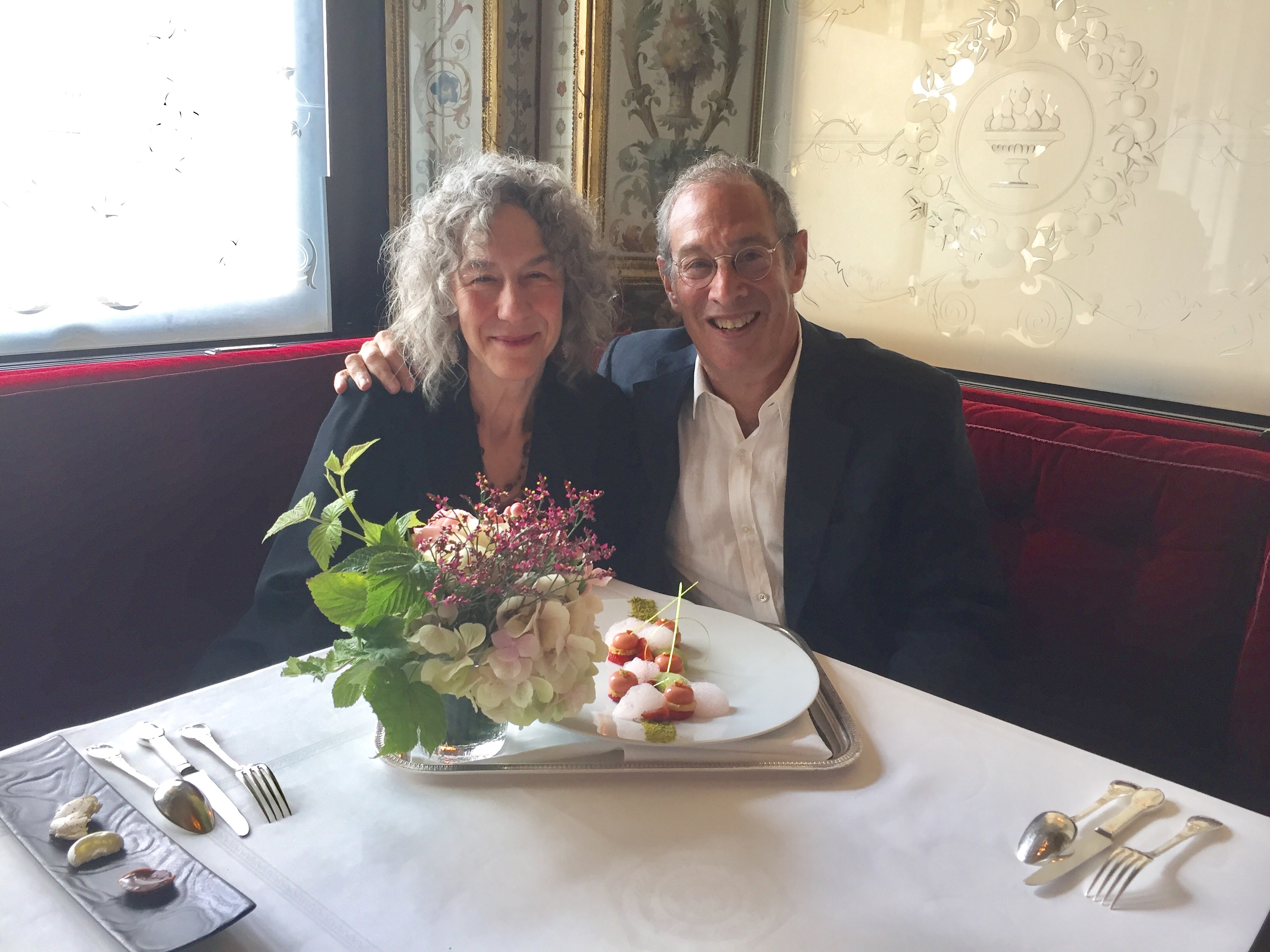
We were more than well nourished – and a wee bit tipsy (note to self: always let the sommelier select the wines – they know) but we miraculously crossed the Rue du Rivoli without getting hit and went to the Louvre. As we entered I recalled Art Buchwald’s advice on the six minute Louvre tour, “It is common knowledge that there are only three things worth seeing in the Louvre. They are the Venus de Milo, the Winged Victory and the Mona Lisa. The rest of the stuff is all junk.” Okay, call me a philistine (though I do have a BFA) but Buchwald was on to something. We are slow walkers, and we had a few drinks, so it took more than six minutes – and we forget about Venus (but she has no arms anyway).
In trying to regain our cultural street cred we did spend an afternoon in Giverney, Monet’s home – Diane’s mother’s favorite painter; and a morning at the Musee d’Orsay, the world’s greatest trove of impressionism. Located in a former train station on the Left Bank, it is a perfect venue for some of the world’s greatest masterpieces. The top floor has the “greatest hits” collection – gallery after gallery of Monet, Degas and Renoir and others. But the really galleries of Paris are the streets. It’s too pretty a city to spend inside. If one has to be inside, the Bar Hemingway at the Ritz Hotel is an excellent option. They do an innovative “Clean Dirty Martini” – freezing an olive in its juice and placing it in the martini so it slowly melts without “dirtying” – French ingenuity at its finest.
Paris notre amour
Our last day in Paris found us at the Café Mabillion once again. We people watched: those of a “certain age” looking so elegant; the young women in their flowing scarfs; and the men with their scruffy facial hair. The air was a little chilly and the leaves were starting to fall. It was truly a perfect way to end our trip and to enter a new season. We were very relaxed. It was the perfect place just “to be.”
 Swimming to Jerusalem
Leave a comment