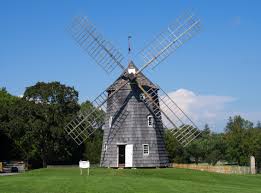
The other Long Island
Even though I grew up sixty miles east, I had never been to the Hamptons until I was in college. My Long Island was certainly different than the charming and now over-glitzed preserve of villages comprising the east end of that 120 mile stretch.
The small neighborhood in Wantagh (not to be confused with Montauk) where I grew up was the final leg of the trajectory that began in the shtetls of Eastern Europe, where my grandparents – and the majority of my friend’s grandparents were from. Our grandparents were part of the great unwashed that came to New York City at the turn of the century. After their less then luxurious trans-Atlantic cruises they regained their bearings on the Lower East Side. When they made a bit of money they moved to Jewish neighborhoods in the outer boroughs of Brooklyn, the Bronx and Queens – preferably to a domicile not over a store and with ‘cross-ventilation’ (The greatest compliment my grandmother could give was noting that someone’s new home had ‘cross-ventilation.’ In her final years she lived in a corner penthouse in Miami Beach that faced west to Biscayne Bay and southeast to the Atlantic Ocean – a far cry from Hester Street.) My parent’s generation bought spanking new split-levels (with multiple cross-ventilated rooms) in predominately Jewish neighborhoods along the South Shore – though miles from the rarefied Hamptons. Some of our grandparents knew each other; our parents had the same cultural references: similar educations (first of their families to graduate college – usually a free CUNY school); foods (bagels on Sunday morning, Chinese food on Sunday night); and vacations (hotels in the Catskill mountains or along Collins Avenue in Miami Beach).
I didn’t realize it then but my generation was to be the last of that re-imagined shetl world. Our education took us to schools around the country. We ate foods unbeknownst to our parents – pesto, sushi, and guacamole. And we traveled to places they never did. We shed the shackles of our grandparent’s immigrant experience and moved light years from our parents. We explored more, we had new experiences; we had relationships and oftentimes married people who were not from our background. For many of us our identity went from “Jewish” to “Jew-ish.” I, and many others never denied the rich cultural and religious heritage we had, but it wasn’t in the forefront of our lives. Our grandparents had escaped the old world with its legacy of virulent hate; our parents were strivers whose goal in life was to achieve the American Dream, and we – and our children – are the beneficiaries. Or so I thought.
Out East
Ah, the Hamptons…as noted it took me until the mid-1970’s to actually visit there when I went out with college friends; someone always seemed to know someone who had a share for the summer. East Hampton was pretty upscale even then; Amagansett less so and Montauk was just a poor relation. Everything ever written about the region appealed to me: the history, the beaches, and the light – especially in the morning and at sunset. The light just wasn’t the same in Wantagh. The water was cleaner than Jones Beach and certainly Coney Island (in those days my time in the ocean was jumping waves in the warm summer sea).
One our first weekend trips after I met Diane was to East Hampton. Prior to her leaving for her research in Peru we stayed at the 1770 House (I must have scrimped quite a bit for that one). When the girls were young our friends Neil and Steve graciously gave us their home in Amagansett each summer where we hung out on the beach, played miniature golf and splurged for breakfast at Babette’s. During the off season we enjoyed it too. We discovered that the Huntting Inn had a bargain winter package – two nights, dinner at the Palm and wine tastings in local vineyards. We started going out there each February – just the two of us (sorry Madeline and Kerry – but we know you enjoyed the few days with babysitters!). On one of those chilly weekends we stopped in at Wolffer Vineyards for a wine tasting. It was sleeting and we were the only ones there. After a few hours of wine and cheese the bartender recommended we join the wine club – four bottle sent to us six times a year. It seemed like an excellent idea. And so we became members of the club (the only club we have ever joined), and the wine arrived regularly. Most of it was good though sometimes there were a few clinkers. At least once a year when we’d review our budget one of us would suggest we should cut the subscription – but alas we never did.
A Little Family Time
A few months back we received a bottle – with our name elegantly written in calligraphy on the label – along with a note that as “esteemed and loyal members of the Wolffer Estate Vineyards Wine Club” we were being gifted a rare vintage and invited to the vineyard for a private wine tasting for a party of six. Clearly membership did have its privileges. So what began as “let’s drive out for the afternoon,” became a family bonding experience when we invited Kerry and Max and Madeline and Kevin to join us – for a weekend. After many emails coordinating schedules we rented a house in Sag Harbor on Airbnb (‘cozy and quirky early 1800’s cottage’) that was exactly as it was described (though cozy meant ceilings that challenged 6’+ foot Max, and quirky meant a septic system installed during the Van Buren administration). We built the weekend around the wine tasting. This included going to Montauk Point, spending time in town (Sag Harbor is the most real of the Hamptons – it’s still easier to purchase a six-pack on Main Street than a Rolex – this is not the case along Main Street in East Hampton), and eating a feast prepared by the girls and their guys in our cozy kitchen.
Saturday we awoke to a Nor’easter. The yard took on a foot of water and looked more like a bayou in Baton Rouge then a hydrangea filled garden in the east end. As with many weekend excursions food is a significant focus: breakfast, then making a list for dinner; then going for lunch before buying the items needed for dinner. After a leisurely breakfast we went to town – arriving just in time for lunch. Though I am a news junkie, I did not see the news that morning. At home I am a creature of habit; I come back from the gym and pick up the New York Times that’s in front of the apartment (I still read the paper – I like that tactile thing), look at the headlines and recall Dorothy Parker’s famous words whenever she answered the phone, “What fresh hell is this?” But, for the last two years I have had a moratorium on buying the paper when I am away. I barely even look at my emails and feeds.
As we sat down to lunch (LT Burger on Main Street – a bit of Madison Avenue in the Hamptons) we noticed the overhead TV screen tuned to CNN. The audio wasn’t on but we read the captions and saw the faces of officials in the now all-too-familiar recitation of tragic events. We talked about it over lunch. Kerry commented that she recently met the Governor of Pennsylvania’s daughter at a wedding. Having gone to college in that state she knew people from Pittsburgh. We tried not focus on it but it was hard – for all of us. After lunch we shopped for provisions and then went to the whaling museum. We watched the film on whaling ships, made Moby Dick jokes and were all thankful we did not live in Sag Harbor in the 1830’s. That night we ate shrimp in a honey sauce, asparagus and homemade blueberry cheesecake. We settled in and watched the World Series. Only Kevin, who is from Albany and which for all practical purposes is part of New England, cared about who would win.
Sunday morning I went to town for bagels (that’s where my Jew-ish roots kick in). I looked at the headlines on the pile of papers and noted the number of people murdered in Pittsburgh was much higher than previously reported. Tempted as I was, I did not purchase the paper. Without reading it I was sad enough. The day was bright, the temporary pond in the yard receded and we drove out to Montauk Point. The light house, commissioned by George Washington, it is an impressive structure. We walked along the rocky shore line where I picked up a lobster claw and scared the crap out of Kerry when I shook her and with it.
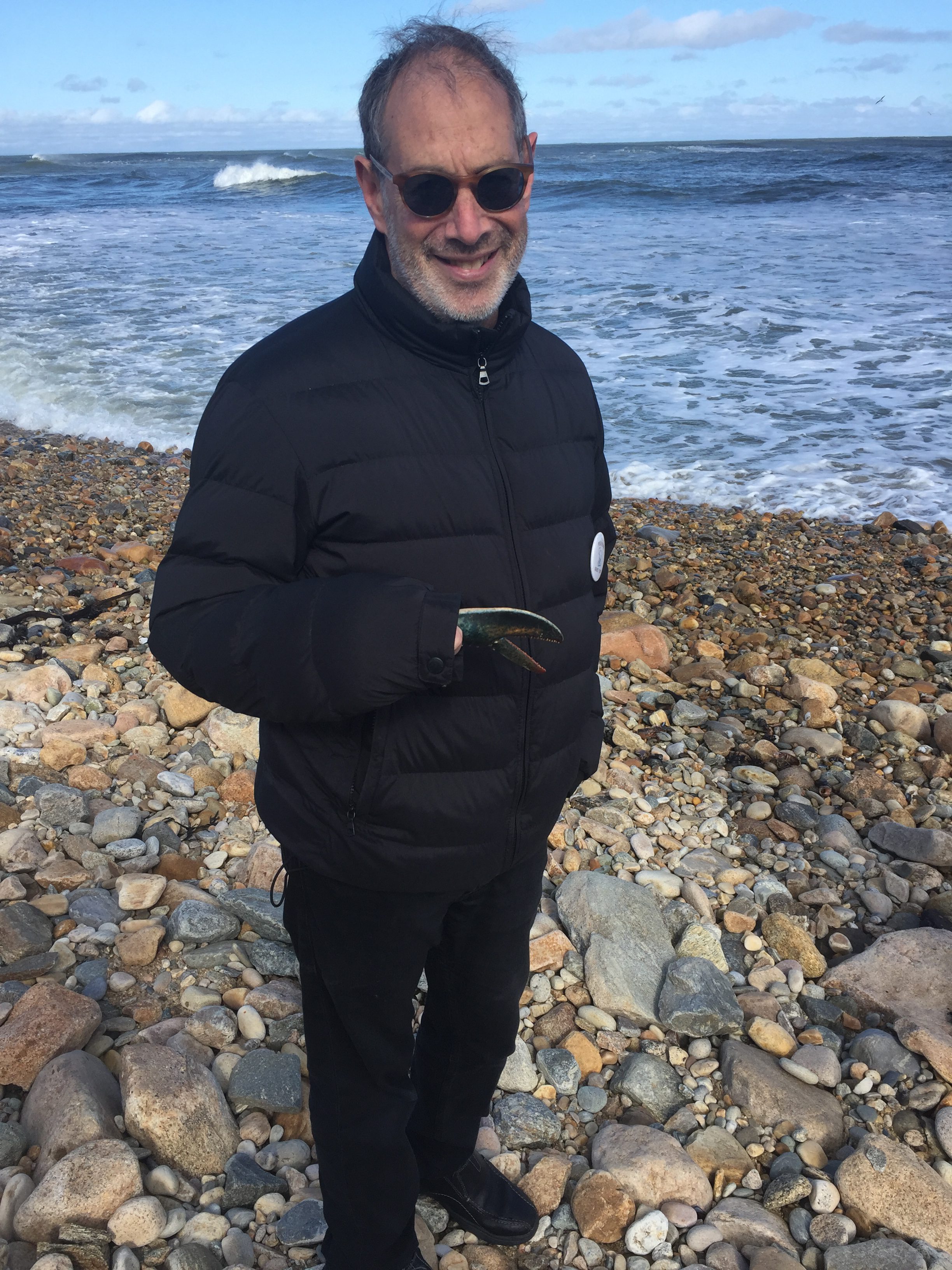
We watched the surfers in wetsuits (weanies – if we had our swimsuits we would have dived in and done a few laps). Later in the day was the wine tasting. It was more elaborate than we anticipated. After a private tour of the vineyards (which resemble Tuscany – especially with that late day light), and the cellars, we were seated at a table for six surrounded by oak casks and Pam, our sommelier, plied us with some great vintages along with cheese and charcuterie. It was a treat. After that was dinner (I did note that food is focus of weekend excursions, right?). We watched the World Series, then as Samuel Pepys’s wrote, “and so to bed.”
Reality
Upon returning home I read the weekend papers and have been obsessed watching the news. No one can make sense of what happened in Pittsburgh’s Squirrel Hill. I couldn’t help but think of my own upbringing. The United States has hundreds of Squirrel Hills – neighborhoods where people put down roots and form communities. Unlike the squalid shetls of yore, or warren of tenements on the Lower East Side; or busy streets of Flatbush; the newer communities were more open. They’re not exclusively one ethnicity, but they have a certain vibe. The only word to describe it is – and I can only fall back on my scant knowledge of Yiddish, the language my parents spoke when they did not want us to know something – is ‘hamish’ – the slang for cozy and homey. Though I haven’t lived in a community like that in over forty years, the memories of it remain in me: Honey Bun Bakery with their tasty French cheesecake; Bellcrest Deli where I worked as the world’s worst waiter in high school; and the synagogue we went to – and the one we never stepped foot in – though I understand that due to changing demographics they have merged. It brings a warm aura and soft images. It was a safe place.
I never thought that America was not a safe place for me and my family; anywhere, whether it was New York or Nebraska. I never truly experienced the anti-semitism the forced my grandparents to leave Europe, or even the subtle anti-semitism my parents knew that kept them in communities where they felt most comfortable. Sure, I have heard dumb jokes and wisecracks, but nothing that I felt that was a threat to me or my family. Once in Omaha we were buying appliances for our home and there was the moment when I asked the salesman if could he could bring the price down if we purchased a washer and dryer at the same time. He nonchalantly said, “No, we don’t Jew down.” I expressed surprise, said “What?” and he repeated himself. I immediately realized this was ignorance, not hatred and was a teaching moment; so I replied, “I’m Jewish and that’s an offensive term.” He was flustered and apologized. When we related the story to Diane’s family that evening at dinner my four brothers-in-law wanted to go back to the store and kick the shit out of the guy (I knew I had married into the right family).
Things We Didn’t Talk About
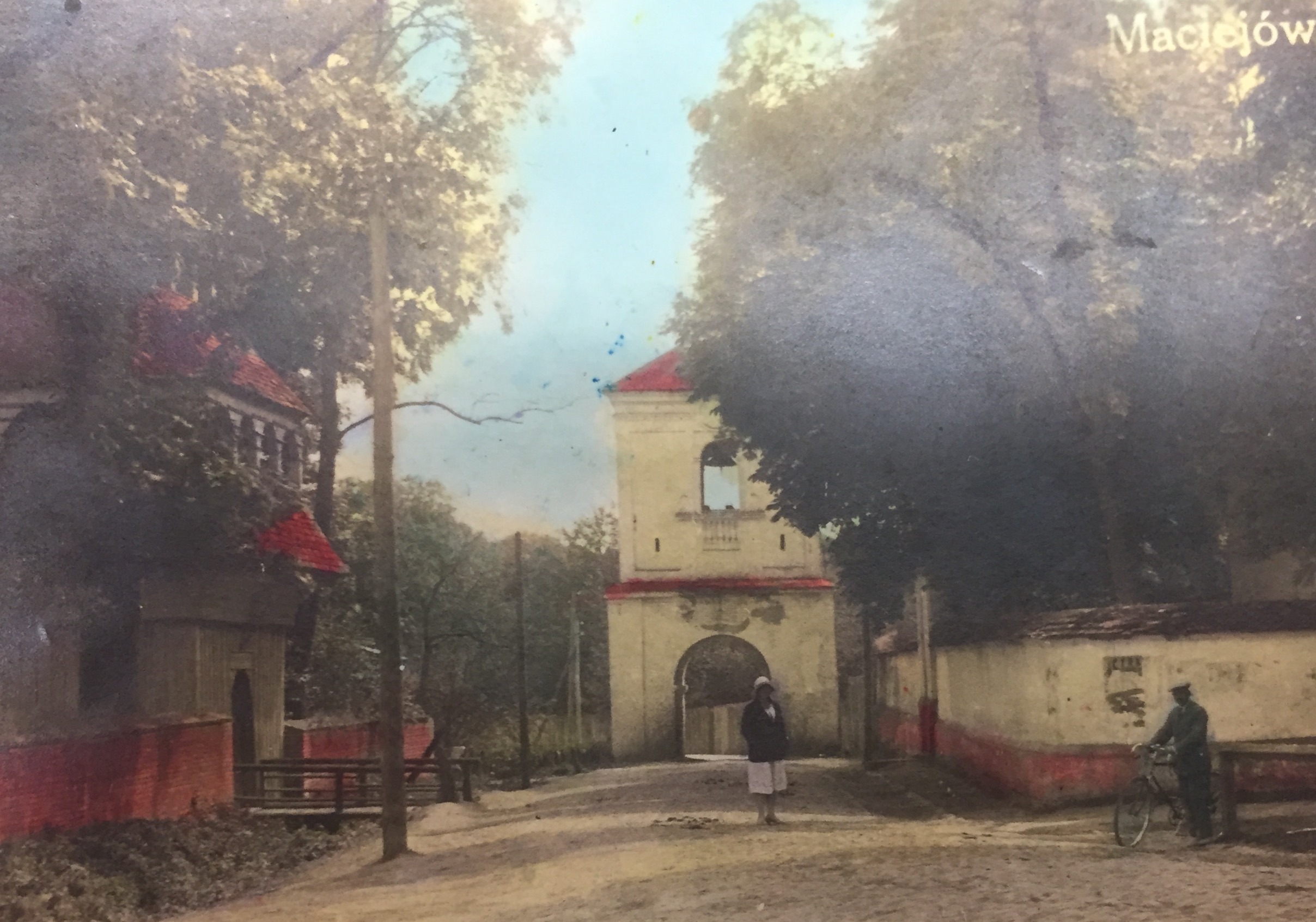
I want to believe there is more ignorance in the world than hatred. Though sometimes history has proven that belief incorrect and possibly dangerous. Early this year I was in Florida with my soon-to-be 98 year-old Dad. He gave me a few photos and postcards he had from my grandfather’s village in Europle. Despite the image in my mind of the shetl as a group of ramshackle homes and mud roads, the postcard depicted a pleasant town square with substantial buildings.
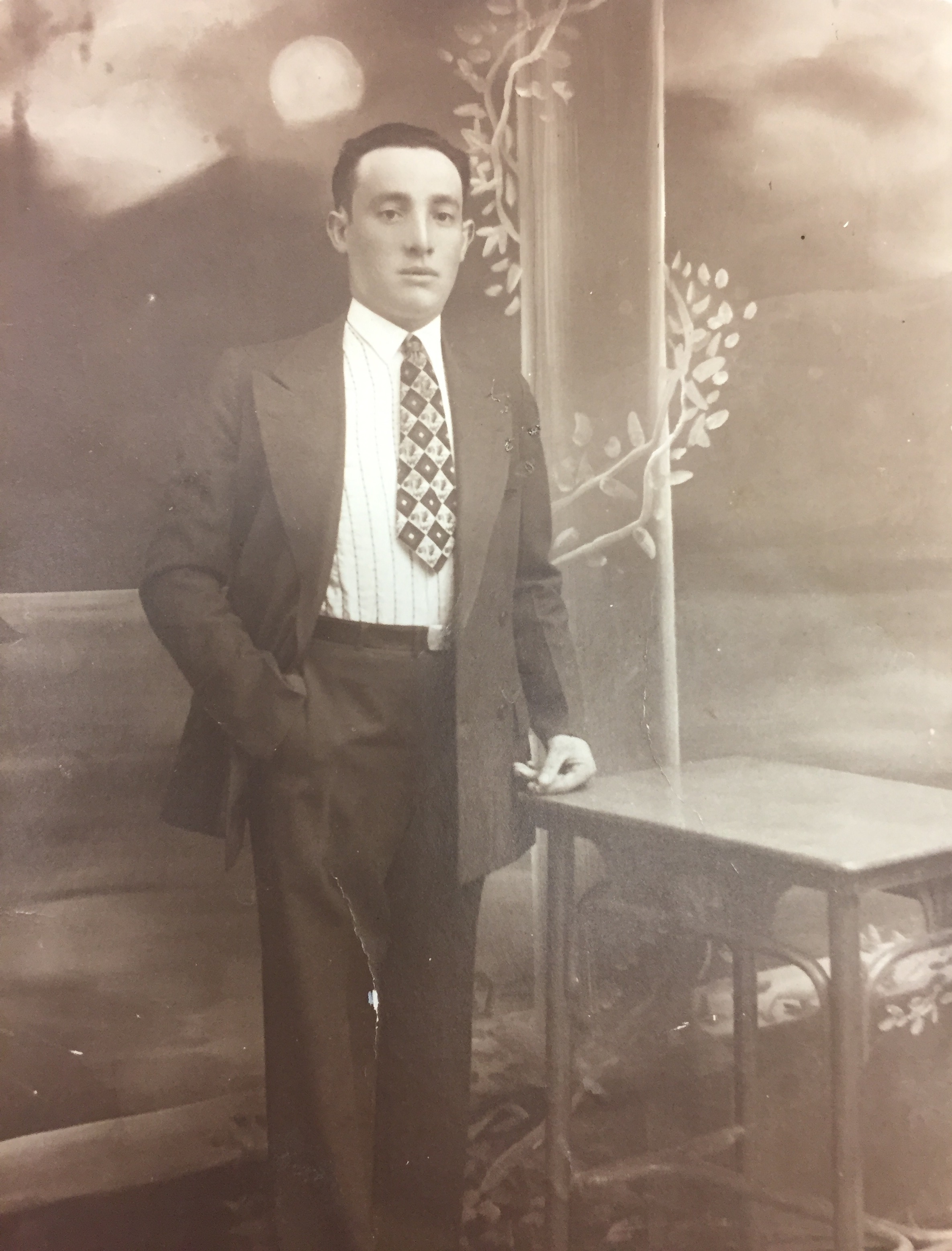
My grandfather and his older siblings came to America in about 1910. But their parents and younger siblings stayed behind. They prospered in their dairy business and built a home in town. Photos of my grandfather’s brother show a fashionably dressed, though serious young man (who my nephew Tyler resembles); not the yarmulke wearing, bearded yeshiva bocher one expects. The family was fairly modern. They lived nicely, they traveled. They may have even gone to vineyards for wine tastings.
Growing up we didn’t discuss the Holocaust. The term wasn’t even used until the 1970’s. It was just referenced as “the war.” I only have one memory of my grandmother talking about Pop’s family who were lost in “the war.” Only when I was in my teens did I learn that my grandfather stopped receiving mail from his family in 1940. When the war ended in 1945 he hoped my Dad, who survived the Battle of Bulge and helped liberate Nordhausen and was stationed in occupied Berlin, would be able to find the family – but post war Europe was a shambles and it was impossible. It was only in the late 1950’s did the family learn from a distant cousin, a doctor who survived, that after the Nazis invaded their town that the family was forced out of their home and sent to live in their barn. One of my grandfather’s brothers tried to sneak back into the house to get medication for their mother and was caught. The Einsatzgruppen came and shot him, the other siblings and their mother. Last weekend, 75 years later, eleven people were murdered the same way and for the same reason – because they were Jewish.
The first burials in Squirrel Hill were of two disabled brothers. Their sister worked for the Pittsburgh Steelers and members of the team served as pallbearers. It should be noted that the first people to be murdered by the Nazis when they came to power were those with disabilities. We have a President who made fun of a person with a disability when ran he for office. His remarks and crude gestures were summarily dismissed by his supporters. Maybe I am connecting dots that aren’t there, but I believe the tinder of intolerance was lit then.
I visited Israel for the first time in1979. A distant cousin, Regina, who was my father’s age and survived the war, and lived in Tel Aviv. We only got to know her in the early 1970’s when the connection was made. My father wrote her a letter informing her that I would be traveling through Europe and Israel but when I arrived at her apartment she had not received the letter and had no idea who I was. Between our few common words in English, Yiddish and French she realized I was a relative and for the next week was treated as an honored guest and fed incredible meals (I will never eat such tasty gefilite fish again). Regina survived the war as a nurse with the partisans in the woods. She was blonde and blue eyed which helped. After the war she was given the Order of Lenin which she proudly wore around her neck. She emigrated to then Palestine where her first husband died in the War of Independence. During that week we communicated as best we could. She showed me the Yizkor Book of my grandfather’s town – a compendium of pictures, stories and lists of those who did not survive. She experienced and witnessed cruelty that I could never imagine. I remember asking her if she hated the world and those that caused her so much hurt. I will never forget her answer. She put her hand over her breast and said, “I have no room in my heart for hate.”
The events in Squirrel Hill exposed the hate in this country. I’m not a Pollyanna, I always knew it was there, under a rock. But I believed the rocks were few and far between. But they have been exposed more than ever in the last few years; in neighborhoods, at schools, in churches and mosques where people once felt safe. I want to think this an aberration, but I am not so sure.
Evening in Vienna
Two years ago Diane and I traveled to Czech Republic, Hungry and Austria (our summer with the Hapsburgs). To my surprise of all the places we went I liked Vienna the most, even though I was predisposed to hate it considering the history there. One day we went to Freud’s apartment at Berggasse 19. I’m not a big fan of Freud, but I was curious to get inside one those old Viennese flats and see what it was like. It’s a nice turn of the century building in a neighborhood similar to the upper west side – no doubt solid and hamish for the many middle class Jewish families that lived there for decades – or so they thought. During the tour of the rambling apartment I read that after the Anschluss there were curfews on the Jewish community and sometimes in the middle of the night families were arrested in their apartment and taken away. Neighbors would hear sirens and the next morning soldiers would be carrying out furniture. No one asked questions.
We were staying at a hotel on the Opernring, across from Opera House. That evening we dressed up and went for drinks at the bar at of the historic Imperial Hotel. We ate dinner (schnitzel I’m sure). It was a lovely summer evening and we then strolled the boulevards and had some sort of dessert concoction (mit schlag) at the Sacher Cafe. We reveled in the grandness of Vienna. With all the walking and eating and drinking we collapsed into our cozy bed at the hotel. It was warm and we left the windows open. The streets were quiet and there wasn’t much traffic. In the middle of the night I was jolted awake by a siren in the distance – it was that distinctly European high/low modulating sound that gets louder as it geta closer. I woke up in a cold sweat. Cell memory, perhaps?
 Swimming to Jerusalem
Leave a comment